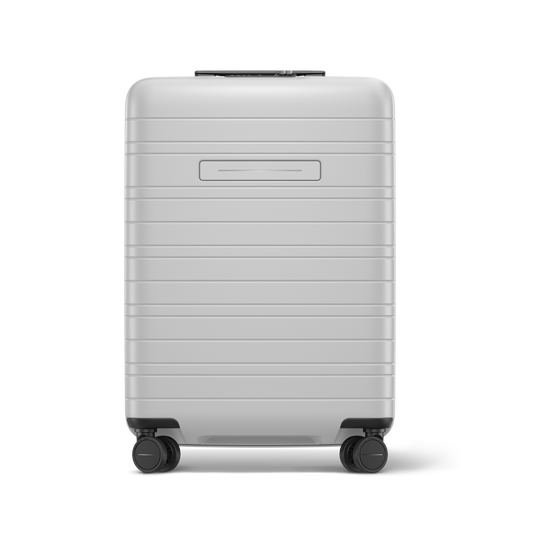
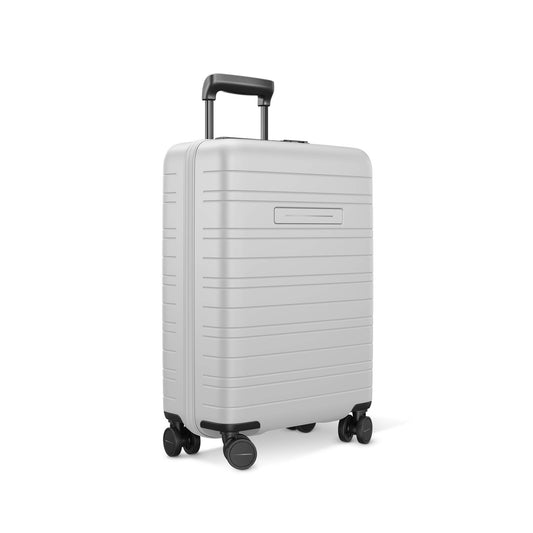
The case interior is where packing efficiency starts
Most cases are neutral. They hold what you put in, in roughly the shape you put it. The H5 Pro and M5 Pro are different. Both include a compression pad built into the lid — a firm panel that presses clothing flat against the base of the case during transit. The effect is practical: a tailored shirt packed on Sunday evening arrives in Munich on Monday morning without the layered creases that come from shifting in the hold. Over five days, that matters.
Both Pro cases also ship with a laundry bag. It goes in empty. Each evening, worn items move into it rather than back into the main compartment. Clean and dirty stay separated for the full trip, and repacking at the end of a stay takes under two minutes. These are not premium extras — they are part of how the Pro interior was designed to function.
Four cubes. Fixed zones. No repacking puzzle
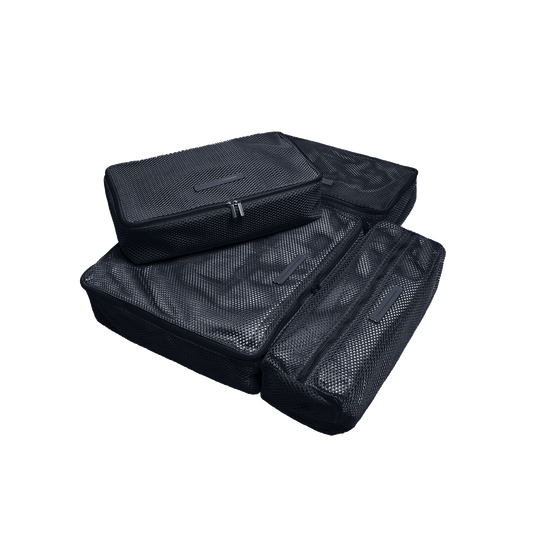
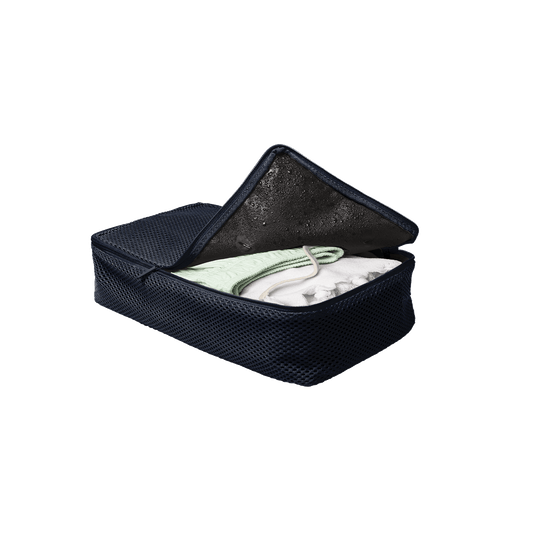
An unstructured case requires a decision about placement every time something goes in. The Horizn packing cube set removes that decision entirely. Four cubes, four categories: tops, bottoms, underwear and socks, and a smaller cube for cables, adapters, a belt, and anything else that would otherwise migrate to the bottom. Each zone is defined before the trip begins and does not change.
The practical result is speed. At a hotel in Frankfurt or Brussels, the cubes come out of the case and go directly into the wardrobe. Departure morning, they go back in. Nothing has to be refound or re-sorted. The compression pad then works more effectively on structured cubes than on loose clothing — the load compresses evenly, sits lower in the case, and moves less during transit.
The M5 front pocket solves the security problem
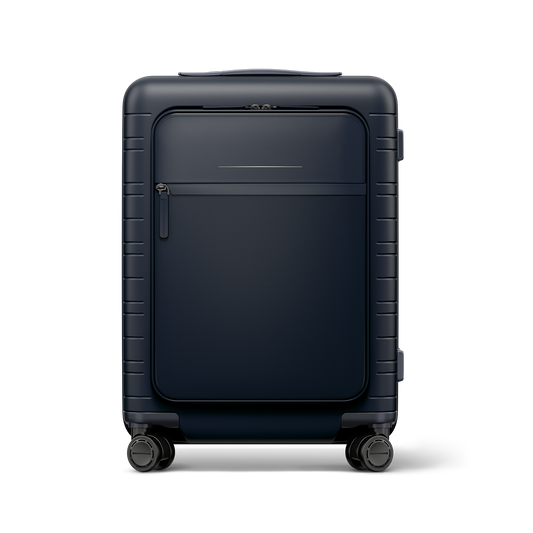
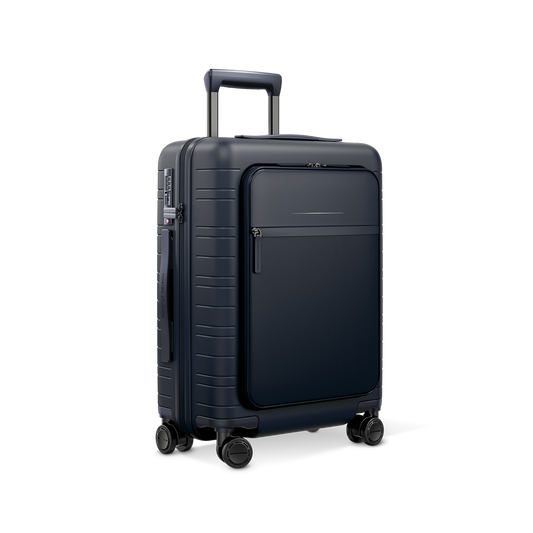
At airport security — Charles de Gaulle, Zurich, Munich, any major European hub — the standard sequence is: remove laptop from case, open case fully, disrupt the packing, reassemble. On a trip with multiple flights, that sequence compounds. The M5 Pro and M5 Essential carry a dedicated front pocket that opens independently of the main compartment. The laptop comes out in one motion. The clothing is never touched.
The pocket works the same way throughout the trip. Boarding passes, a passport, a return hotel confirmation — anything that needs to be produced at a gate or a check-in desk lives at the front of the case rather than somewhere inside it. For travellers on two or three flights a week, the cumulative time recovered is not insignificant.
Empty weight is a capacity decision
Carry-on allowances on European short-haul routes — Lufthansa, Eurowings, Swiss, Austrian — are typically a combined weight figure. The case weight counts against that total. A cabin case at 3.5 kg empty leaves less room for clothing than one at 2.1 kg, by definition.
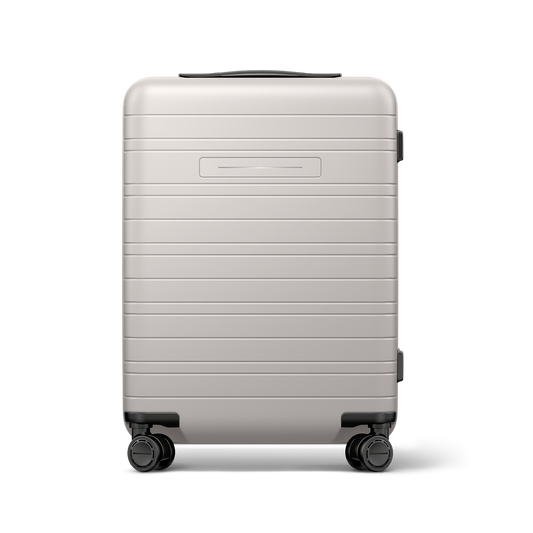
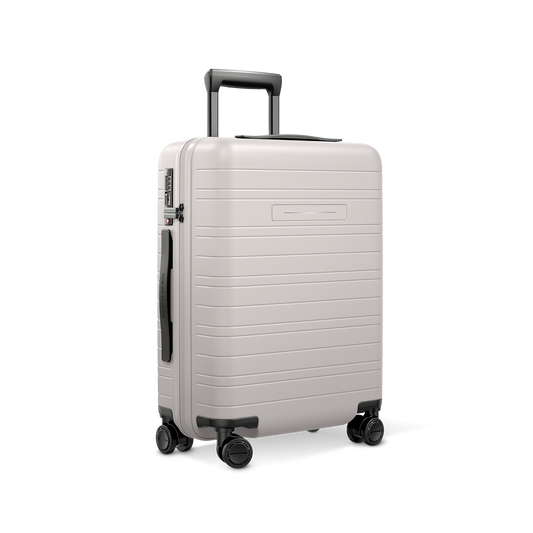
The H5 Air was developed with that constraint as its primary design brief. At 2.1 kg, it is the lightest cabin case in the Horizn range. The saving did not come from reducing the polycarbonate shell — it came from engineering the wheels, handles, and zippers individually for minimum weight. The 800 g difference over the H5 Pro is approximately two shirts, or a business shoe. On a five-day trip with a strict 8 kg cabin allowance, that margin is not academic.
One case for clothing. One bag for work
The most consistent feature of efficient business packing is structural, not technical. The cabin case handles clothing. The personal item handles the working day. Nothing crosses between them. The result is that security, boarding, and in-transit access all become faster — because the right compartment is always the right one.
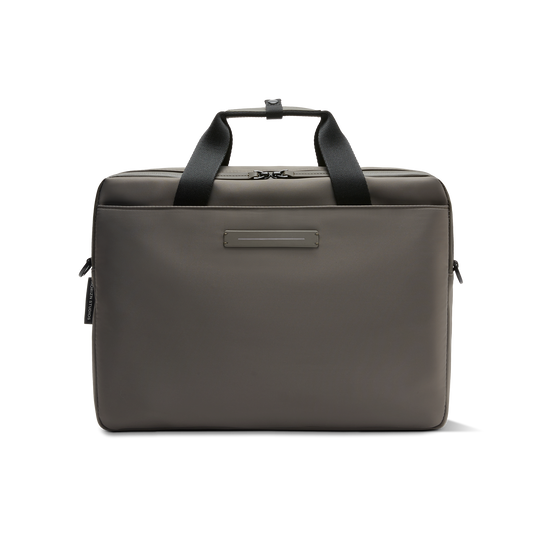
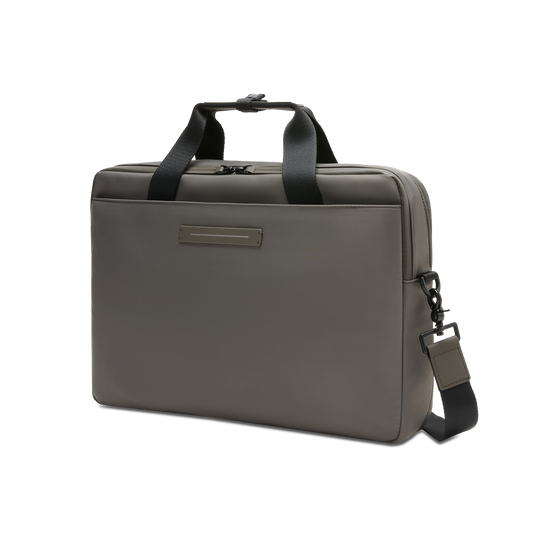
The Gion Backpack Pro (23L, 750 g, recycled nylon) sits alongside any Horizn cabin case via a luggage strap and carries a 16" laptop in a dedicated rear compartment, separate from the main body. Valuables sit in a hidden pocket at the back panel. For a setup where documents and meeting materials need more organisation than a backpack allows, the Gion Briefcase (10L, 1 kg) provides structured compartments for laptop, papers, and accessories, with a luggage strap that doubles as additional storage when needed. The Midtown Briefcase (13L, 1 kg, ballistic nylon) adds a detachable shoulder strap and waterproof zippers for heavier road use.
The lining detail that contains the damage
Across both the Pro and Essential series, the main compartment is lined with a liquid-repellent fabric. A shampoo bottle that opens under pressure at altitude, a hand cream with a loose cap — both stay contained within the lining rather than reaching the clothing. The lining does not prevent leaks. It limits the consequences of one. On a week-long trip with one case, the difference between contained and soaked is the difference between a functioning wardrobe and an expensive problem at a hotel sink in Milan.
The complete system
Efficient cabin travel for a full working week is not about packing less. It is about removing the decisions, the delays, and the friction points that accumulate across five days and multiple airports. The compression pad keeps clothing flat. The packing cubes fix the interior layout. The M5 front pocket handles security without opening the case. The laundry bag separates clean from worn throughout. The right personal item keeps work separate from clothing entirely.
The Pro series integrates all of those systems as standard. The Essential series delivers the same German polycarbonate shell and silent 360° spinner wheels at a lower price point, with dual mesh dividers in place of the compression pad. Either works. The packing cubes and the right personal item complete the setup regardless of which series you choose.
Frequently asked questions
What separates the Pro series from the Essential series for business travel?
The main practical difference is the interior: the H5 Pro and M5 Pro include a compression pad, laundry bag, and ball-bearing wheels. The H5 Essential and M5 Essential have dual mesh dividers and silent spinner wheels. Both use the same premium German polycarbonate shell with the same cabin dimensions (55 × 40 × 20 cm for H5, 55 × 40 × 23 cm for M5). The Pro interior is the better fit for five-day trips where arriving wrinkle-free matters. The Essential is the cleaner choice for shorter trips or tighter budgets.
Why choose the M5 over the H5?
The M5 Pro and M5 Essential add a dedicated front pocket sized for a laptop and travel documents, accessible without opening the main compartment. On a trip involving security checks at Charles de Gaulle, Amsterdam Schiphol, or Frankfurt Airport, that single feature saves meaningful time across a week. The H5 is the right choice when front-pocket access is less important than maximum interior volume.
How much does empty case weight actually matter?
On routes where the combined carry-on allowance — bag plus contents — is 8 to 10 kg, it matters directly. The H5 Air at 2.1 kg leaves 800 g more usable capacity than the H5 Pro at 2.9 kg. That translates to roughly an extra shirt, a pair of shoes, or a heavier toiletry bag. On Ryanair, Eurowings, or Wizz Air fares with stricter cabin weight limits, the H5 Air is the practical choice.
Do packing cubes work with the Pro series compression pad?
Yes, and the combination is more effective than either alone. The compression pad applies even pressure across the cubes rather than loose clothing, which means the load sits lower, compresses more uniformly, and shifts less in transit. The four-cube set fits the 36L H5 and 37L M5 main compartments with space to spare.
Which personal item works best for a week-long business trip?
That depends on working style. The Gion Backpack Pro (23L, 750 g) suits most setups — separate laptop compartment, luggage strap for the case handle, hidden valuables pocket. The Gion Briefcase (10L, 1 kg) works better when document organisation is the priority. The Midtown Briefcase (13L, 1 kg, ballistic nylon) is the more durable option for frequent or intensive road use, with a detachable shoulder strap and waterproof zippers.
What are the cabin size limits for European airlines in 2026?
Standard allowances across major European carriers: Lufthansa and Swiss at 55 × 40 × 23 cm, Air France at 55 × 35 × 25 cm, Ryanair at 40 × 20 × 25 cm for smaller bags (larger bags require a seat or fare upgrade), EasyJet at 56 × 45 × 25 cm, Eurowings at 55 × 40 × 23 cm. The H5 and M5 series sit within the majority of these allowances at 55 × 40 × 20 cm (H5) and 55 × 40 × 23 cm (M5). Always confirm against the specific fare class before travel — restrictions vary.